
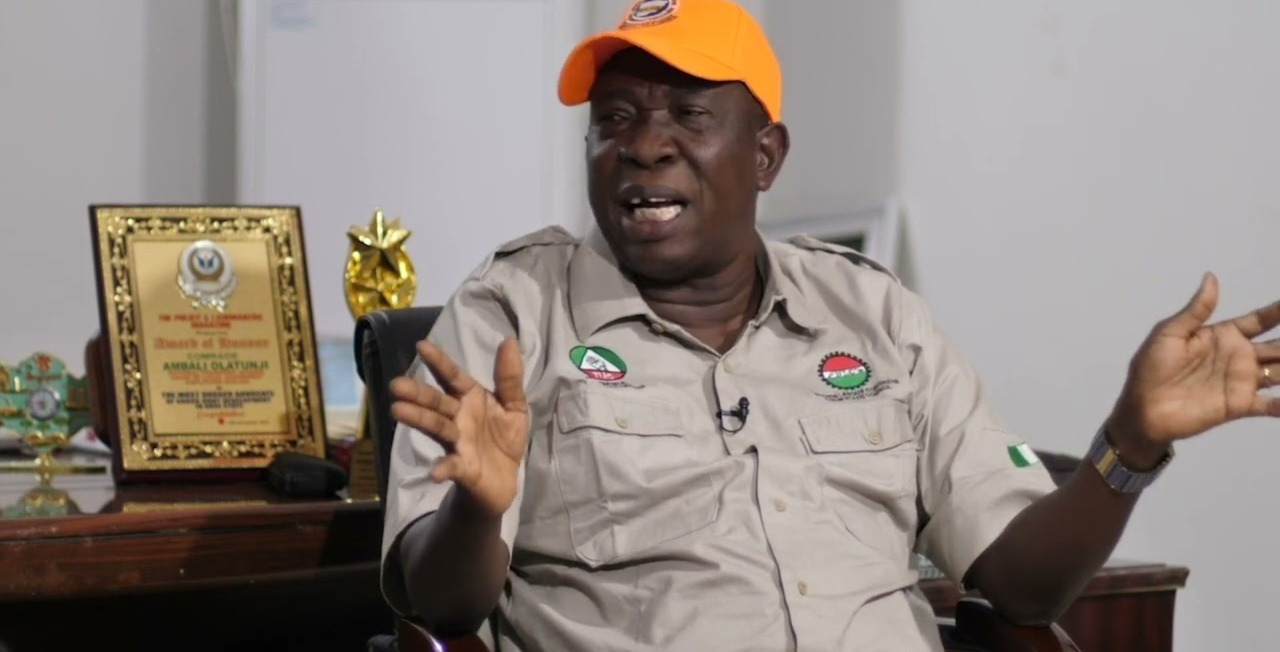
Former National President of the Nigeria Union of Local Government Employees (NULGE), Comrade Akeem Ambali, has warned that the growing disagreement between the Nigeria Labour Congress (NLC) and the Trade Union Congress (TUC) could weaken organised labour’s bargaining strength and undermine efforts to protect Nigerian workers.
Ambali, a former Treasurer of the NLC and former Ogun State Chairman of the Congress, said the disagreement over the Federal Government’s proposed ₦70,000 transport allowance was an unnecessary distraction at a time workers were struggling with rising living costs, declining purchasing power and increasing transportation and energy expenses.
He spoke on Tuesday, November 3, 2026, during an interview on Frontline, a current affairs programme on Eagle 102.5 FM, Ilese-Ijebu, Ogun State, where he examined the disagreement between the two labour centres and the implications for workers’ welfare.
Recall that the disagreement between the Nigeria Labour Congress (NLC) and the Trade Union Congress (TUC) centres on the Federal Government’s ₦70,000 transport allowance for public sector workers.
The rift escalated in November 2026 after NLC President Joe Ajaero signed a Memorandum of Understanding with the Federal Government without the TUC’s participation.
TUC President Festus Osifo rejected the arrangement, insisting that his congress had not been carried along and was entitled to pursue its own negotiations. The disagreement has since extended beyond the allowance, with both labour centres exchanging criticisms over their respective roles and leadership, raising concerns about the implications of the division for organised labour’s collective bargaining strength.
Describing the development as unfortunate, Ambali said organised labour should be concentrating on negotiating better wages, improving social services and addressing the economic conditions affecting workers rather than engaging in disagreements over leadership and representation.
He argued that the removal of fuel subsidy, inflation and the floating of the naira had significantly eroded workers’ earnings, leaving many unable to meet their basic needs despite the implementation of the ₦70,000 national minimum wage.
“At this point in time, when Nigerian workers are undergoing very serious economic challenges, occasioned by the removal of first subsidy and the galloping inflation and the floating of Naira, we know that workers’ salary, workers’ income can no longer take them home,” he said.
Ambali said transportation and electricity expenses had become major drains on household incomes, explaining that workers were paying more whether they owned private vehicles or depended on public transportation, while erratic electricity supply forced households to spend additional money on alternative power sources.
He maintained that the consequences extended beyond workers’ personal finances to the wider economy, as high production costs continued to affect businesses and make goods and services increasingly unaffordable to ordinary Nigerians.
According to him, organised labour should be pressing for improved wages, minimum pensions for retirees, accessible healthcare and affordable social services, rather than allowing internal disagreements to consume the energy required to negotiate better conditions for the workforce.
He also explained that workers’ purchasing power was essential to the survival of local businesses because salaries earned by workers were largely circulated within domestic markets instead of being transferred abroad or used for capital flight.
“Because workers cannot exist in a vacuum. They exist within the society. And they are the medium of circulating wealth in the country because it’s only workers who collect their salary and go to local markets like Oke-aje, Ijebu-imushin and all,” Ambali said.
He added that improving workers’ earnings would strengthen domestic consumption and contribute to economic growth, arguing that government policies should recognise the relationship between household purchasing power and the performance of the local economy.
Addressing the disagreement over the transport allowance, the former labour leader recalled that he participated in the negotiations that produced the ₦70,000 minimum wage in 2024, insisting that the established practice was for the NLC, TUC and Joint Negotiating Council (JNC) to participate in negotiations affecting the wider workforce.
He explained that while the two congresses retained their independence to negotiate on behalf of their respective members, agreements intended to cover workers generally required cooperation between the labour centres and the negotiating council.
Ambali recalled that representatives of the TUC, led by Comrade Osifo, were physically present during the 2024 minimum wage negotiations, while Comrade Joe Ajaero led the NLC delegation, alongside representatives of the Joint Negotiating Council.
He said the participation of both congresses in such negotiations did not diminish their individual authority but strengthened the legitimacy of agreements reached on behalf of workers across different sectors.
He therefore faulted the failure to properly carry the TUC along in the latest negotiations, arguing that the NLC should have briefed its counterpart and allowed it to understand the circumstances surrounding the agreement with the Federal Government.
“The outcome of it revealed that they are supposed to have done this thing, properly than this. I expect to, TUC to have not, not to have responded openly. I expect NLC to walk down to TUC, to tell them, my brother, we were invited, but we defended,” he said.
Ambali maintained that the TUC should not be treated as a junior partner simply because the NLC had a larger membership, stressing that both organisations were registered labour centres with recognised structures and responsibilities.
He further argued that the NLC could have invited the TUC to countersign the agreement after explaining the circumstances surrounding the negotiations, rather than allowing the disagreement to escalate publicly.
“This is our agreement. You can even counter-sign. It’s not too much. What are we hiding? Are we not defending the interests of workers? And for TUC not to agree, you need to also key him in. Key the president of TUC in. You need to tell him, the intricacies of that agreement, what happened. You must tell him,” Ambali said.
He also acknowledged the TUC’s concerns about the Federal Government’s record of implementing agreements, noting that previous wage-related commitments had not always been honoured and that the congress was entitled to seek assurances before accepting another arrangement.
According to him, the distinction between minimum wage, living wage and wage award should be properly understood, particularly because the government had previously failed to implement the ₦30,000 wage award as expected.
“Why TUC is apprehensive is that there are records of inconsistency and failure of government to implement even the wage award of 30,000. And what is the assurance that government will implement 70,000 minimum wage? That is the concern of TUC,” he said.
Despite acknowledging those concerns, Ambali argued that rejecting the transport allowance outright would not serve workers’ immediate interests, particularly as the additional payment could provide some relief amid rising transportation expenses.
He insisted that the TUC should not direct its members to reject the allowance, even while demanding better remuneration and more comprehensive welfare arrangements from the government.
“It will be suicidal for TUC to direct that its member will not take it. They will take it. No worker see money and forget about money. Even you and me, if you send a lot of additional 70,000 in your pay, nobody will call you to tell you anything,” he said.
However, he described the ₦70,000 allowance as inadequate when measured against current transportation and living costs, estimating that it amounted to slightly more than ₦2,000 daily and questioning what meaningful relief workers could obtain from such a sum.
He said the allowance should not be mistaken for a comprehensive solution to workers’ economic difficulties, insisting that labour organisations must continue demanding wage improvements and policies capable of restoring purchasing power.
Ambali also called for preparations to begin ahead of the next national minimum wage negotiations, expected to commence in April, urging the NLC and TUC to jointly engage economists, professors, technocrats and other specialists to develop a strong negotiating position.
He described negotiations as a process requiring research, internal consultations and technical preparation, warning that labour organisations should not wait until the government convened negotiations before developing their demands.
“Labour bring out technocrats, economists, professors of economic science and history to come down here together. That’s the way we start. They will develop some paper. We’ll have our own seminar internally. That’s why at negotiation, you don’t find labor wanting,” he said.
Ambali proposed that the next national minimum wage should not be less than ₦400,000, arguing that workers’ earnings must reflect the increasing costs of transportation, housing, energy and other essential expenses.
He further urged the labour centres to ensure that any agreement reached at the national level was extended to state governments and the private sector, noting that the Federal Government’s agreement alone might not automatically guarantee implementation across other employment categories.
He cautioned that the disagreement could also affect existing industrial relations arrangements, particularly where both congresses had jointly issued demands or participated in declaring industrial disputes.
Drawing from his experience as former Ogun State NLC chairman, he recalled an instance when he had to suspend a planned strike after his counterpart in the TUC reached a separate understanding with the government, explaining that the decision was necessary because both organisations had jointly declared the dispute.
“I declared seven days’ strike in Ogun State then, when I was NLC chairman. We were in the negotiation of the Federal Ministry of Labor. I never knew that my counterpart has been approached by government to back out of the agreement. As we were negotiating, he just stood up and said, what is the area that we have in this disagreement? He told him, he said, this is convenient, this is agreeable by us, my people want that. At that level, I have to make a tactical retreat. Because I know two of us declared the trade dispute. I can’t alone go into it. Because when it comes to a labor arbitration panel or labor court, if two of you believe together in this thing, I won’t pull out, It will affect the other. We have to look for a way. I have to come back, withdraw on that, wait for some time to renegotiate and declare trade dispute, singularly as NLC.”
He further explained: “But then, I still went to TUC to inform them. We are taking this step. Yes. We are taking this step. They said they are not part of it, I said it doesn’t matter. Bro, I have to inform you, I have to carry you along.”
And on the eventual outcome: “But provided this agreement, these disputes succeed, your members will benefit. And surprisingly, when we started, the member of the other group joined me. They joined me. Even when I went to lock the government office, all of them drooped out and they showed their solidarity. And that was what informed the government and they quickly signed an agreement with us. So it depends on how you manage it.”
He said he subsequently informed the TUC about the NLC’s decision to proceed independently, stressing that keeping the other labour centre informed was necessary even when it was not directly participating in the action.
Ambali therefore advocated a review of Nigeria’s labour laws to establish clearer rules for negotiations affecting all workers, insisting that registered labour organisations should not be excluded from discussions concerning their members.
“Well, it’s simple. The obsolete labor laws in Nigeria need to be reviewed. If a government register a body and give it power to negotiate, and you want to negotiate issue of workers’ welfare concerning them, why must you sideline them? So the labor law must reflect that any agreement that is global in view that will affect all workers, the three bodies must be fiscally present to agree to sign,” he said.
A caller, Prince Suleiman Hassan, who contributed to the programme, also urged the two labour centres to resolve their differences, arguing that workers were more concerned about receiving the benefits negotiated on their behalf than disagreements among union leaders.
Ambali maintained that the immediate responsibility of organised labour was to restore cooperation, protect workers’ interests and prepare for the next round of negotiations, warning that prolonged disagreements could weaken the collective strength needed to hold employers and government accountable.
He called on the current leadership of the NLC and TUC to put aside personal interests and work together, insisting that the survival of organised labour depended on its ability to resolve internal disputes without compromising the welfare of the people it represents.