
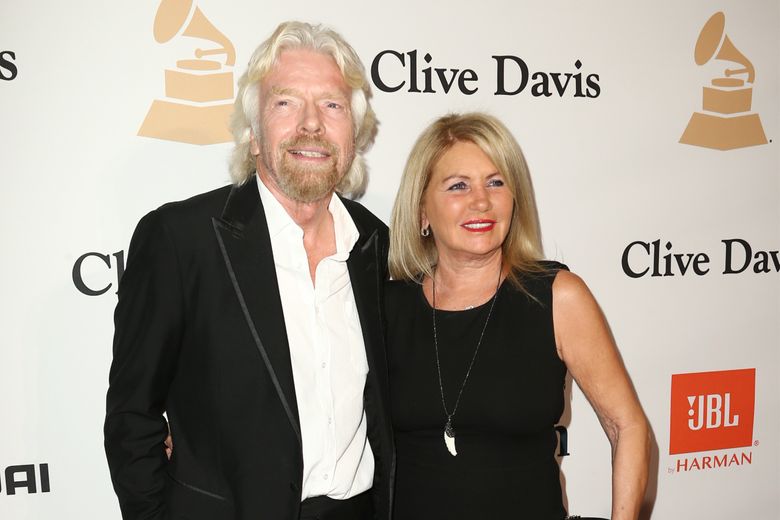
Lady Joan Sarah Drummond Branson, wife of Sir Richard Branson died aged 80 in November 24, last year at The Lister Hospital from a blood clot. She was admitted into The Lister Hospital from complications following a fall-induced back injury two weeks earlier.
But the private hospital’s failure to provide preventative medication contributed to the death of Sir Richard Branson’s wife, an inquest has concluded.
She suffered a cardiac arrest at the private Lister Hospital in Chelsea, west London, which is owned and operated by HCA Healthcare.
Westminster Coroner’s Court heard on Wednesday that she died after suffering a pulmonary embolism, a sudden, dangerous blockage in a lung artery, resulting from deep vein thrombosis.
The virtual inquest heard that Lady Joan was admitted to the hospital on November 17 after a fall weeks earlier on Necker Island – a private luxury retreat in the Caribbean’s British Virgin Islands owned by her billionaire husband.
Professor Fiona Wilcox, senior coroner for Inner West London, said Lady Joan did not receive prophylactic anticoagulants at the hospital despite a “very high risk of developing deep vein thrombosis”.
Giving her conclusion, the coroner said: “I do find her death would have likely been prevented and the lack of anticoagulation did cause or contribute to her death probably.”
Lady Joan also did not receive an immediate Venous Thromboembolism (VTE) assessment to check her risk of developing harmful blood clots, the inquest heard.
Dr Adams said “any patient who comes into hospital should have an immediate VTE assessment to determine their risk of bleeding”.
Lady Joan’s daughter, Dr Holly Branson, told the inquest that her mother also did not have Thrombo-Embolus Deterrent stockings – which are designed to prevent deep vein thrombosis by promoting blood flow in the lower legs – for the first 48 hours after being admitted.
The hospital’s admitting doctor, Dr Basir Kunduzi, did not complete a bleeding risk assessment on the day of her admission, the inquest heard.
Dr Kunduzi said Lady Joan “should have been on anti-coagulants” and her death led him to “reflect on my role as a doctor” and the importance of “good communication between team members”.
Resident medical officer Dr Nevil Pavithran told the inquest that Lady Joan “should have received her first dose of anticoagulation prophylaxis within 12 hours of admission”, adding this not occurring caused a “significant risk”. The doctor said he had “spent quite a lot of time going over the incidents” and said he felt he “should have been more forceful”.
Lady Joan’s consultant, Dr Inaki Bovil, said there had been a “lot of work at the Lister to make it more robust around VTE and risk prevention” and to “prevent this from happening again”.
Earlier this year, Sir Richard and Joan’s daughter Holly, 44, said that the family was not looking to blame anyone for her death.
However, the inquest has looked at whether Lady Branson should have been prescribed blood thinners and if she was wearing anti-clot stockings at the time of her death.
Speaking at the hearing at Inner West London Coroners’ Court, Holly said: “I believe mum had great care. The doctors saved her life three years ago, giving us all three more years together. We just want to help other families if there are any lessons to be learned.”
Senior Coroner Professor Fiona Wilcox previously told the court the inquest would establish whether or not Lady Branson was wearing Thrombo-Embolus Deterrent – or TED – stockings, which reduce the risk of blood clots and are worn by patients during periods of inactivity.
Prof Wilcox told the court that statements from an expert witness would be needed to determine whether a prescription of the anti-coagulant Heparin “would have prevented Lady Branson’s death”, given that she had a previous history of clots.
An expert haematologist will present a report of their findings at the inquest, scheduled for September.
Joan’s history of blood clots went back to at least 2010. In 2018, Sir Richard shared that one morning around eight years previously Joan had woken up to find her leg three times its normal size – which led to her undergoing a novel new treatment.
She had suffered a series of clots from her ankle up to her groin – the “worst case” doctors at that hospital had ever seen.
Sir Richard said: “She was in great danger of a pulmonary embolism, as bits of the clot threatened to break away and travel to her lungs. The doctors put her on a drug called Warfarin, pulled a compression stocking over her leg and told her that over a number of years the leg would gradually improve, but that at any stage she might suffer a major pulmonary embolism that could kill her.”
But she underwent surgery that put a tiny umbrella inside her leg so that if any clot did break off, it could not enter her lungs. “Two days later, she nearly skipped out of the building!” he added.
He broke the news of his wife’s passing on Instagram on November 25 last year.
He said: “Heartbroken to share that Joan, my wife and partner for 50 years, has passed away. She was the most wonderful mum and grandmum our kids and grandkids could have ever wished for.
She was my best friend, my rock, my guiding light, my world. Love you forever, Joan x”
A day later, on virgin.com, he wrote a longer tribute. He said: “Joan was the most wonderful partner, friend, mum and grandmother we could ever have wished for. Holly, Sam and I are all together now, doing our best to smile through the tears and to focus on all the good things she brought into our world. There are so many.
“We had a lovely lunch that day. She was in positive spirits and getting stronger. She smiled at me, that radiant smile that lit up her whole face, the same smile I fell in love with the very first moment I saw her, half a century ago. Then suddenly, she was gone, quickly and painlessly. And thankfully, I was right by her side. It brings us all great comfort to know we were together.”
Sir Richard and Joan’s love story began in 1976, when the fledgling tycoon met the then Joan Templeman at The Manor, the live-in recording studio he had built for Virgin Records. She worked in an antiques shop called Dodo in Notting Hill, close to the Virgin office.
Glasgow-born Joan was a former model, at the heart of Swinging London’s vibrant music and fashion scene. Sir Richard found excuses to visit her shop, amassing a huge collection of antiques he didn’t really need.
At the time, Joan was still married to her first husband, rock pianist Ronnie Leahy, and the pair embarked on an affair.
Joan took a while to warm to the charm offensive, but Sir Richard’s persistence – lavish gifts, impromptu trips, even halting a taxiing plane at Heathrow to whisk her aboard – wore down her reservations.
Tragedy struck when Sir Richard and Joan’s first child, Clare Sarah, was still-born in 1979. Joan would go on to support premature birth-charities as part of her philanthropic work later in life. The couple’s children Holly and Sam were born in 1981 and 1985. Joan’s five grandchildren also survive her.
Source: Mirror